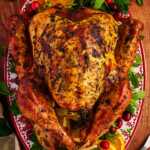
Juicy Roast Turkey
A foolproof, show-stopping holiday Roast Turkey rubbed inside and out with a fragrant garlic, lemon, and fresh herb butter. Sear-roasted at high heat and shielded with foil for crispy golden skin and ultra-juicy, tender meat every time!
Servings: 10 servings
Ingredients
For the turkey
- 1 ~12 pound fresh or safely thawed turkey adjust amount of other ingredients if your turkey is significantly smaller or larger
- salt and freshly ground black pepper to taste
- 1-2 medium onions peeled and quartered
- 1 medium lemon quartered
- 4-8 cloves garlic crushed
- 2 bay leaves
- fresh parsley and/or thyme
- flaky sea salt optional
Lemon, herb and garlic butter
- 2 sticks butter softened at room temperature
- 1 tablespoon olive oil plus more for drizzling
- 2 teaspoons sea salt
- ½ teaspoon ground black pepper
- 3 tablespoons lemon juice
- 2 teaspoons grated lemon zest
- 4 medium garlic cloves grated or pressed
- ½ bunch flat leaf parsley leaves only, chopped
- 1 tablespoon thyme leaves
- 1 tablespoon finely chopped fresh sage
Instructions
- Prep: Preheat oven to 430°F. You need a large roasting pan for this recipe. The exact roasting temperature depends on your oven, the shape and size of your turkey, and your roasting pan. Since the bird needs to rest for quite a long time after roasting anyway, I generally recommend to start earlier rather than later.
- Prep turkey: Remove the thawed turkey from the fridge about 30 minutes before roasting. (The time you need to prep the bird for the oven counts towards this time, too!) Remove the neck and giblets from the cavity. If you want to use them for the gravy, place them on the roasting pan with the turkey later.Season the turkey cavity well with salt and pepper. Stuff with onion, lemon, garlic and bay leaves (cavity should be about half-empty for air circulation, do not overstuff). If you have any leftover parsley or thyme after making the herb butter, you can place it in the cavity, too (if using thyme, stick to 4-5 sprigs, otherwise it will overpower the flavors).1 ~12 pound fresh or safely thawed turkey, salt and freshly ground black pepper, 1-2 medium onions, 1 medium lemon, 4-8 cloves garlic, 2 bay leaves, fresh parsley and/or thyme
- Make herb butter: Mix the softened butter with olive oil, salt and pepper. Add the remaining ingredients and mix well until combined. It’s difficult to incorporate the lemon juice - don’t worry if a teaspoon or so remains pooling around the butter. I mash it with a fork. Set aside.2 sticks butter, 1 tablespoon olive oil, 2 teaspoons sea salt, ½ teaspoon ground black pepper, 3 tablespoons lemon juice, 2 teaspoons grated lemon zest, 4 medium garlic cloves, ½ bunch flat leaf parsley, 1 tablespoon thyme leaves, 1 tablespoon finely chopped fresh sage
- Butter the turkey: Loosen skin on breast from both ends, leaving the skin intact. Stuff ⅔ of the butter mix under the skin, spreading it by massaging from the outside. Place the turkey in your roasting pan, breast side up. Pat the skin dry. Spread the turkey skin with remaining butter all over. Drizzle with olive oil and season with salt and pepper (I like to use flaky sea salt for salting the skin, but regular works just fine.) Tuck the wing tips under the bird so they don’t burn.flaky sea salt
- Oven sear: Roast the turkey at 430°F for 15-20 minutes, until starting to brown on top.
- Baste and finish roasting: Reduce the oven temperature to 350°F. Remove the roasting pan with the turkey from the oven, carefully baste the turkey with pan juices, and cover just the breast part with aluminum foil (fold a square of foil into a triangle, lightly oil one side and cover just the breast part.) Roast for 13-15 minutes per pound (about 1h 45min to 3 hours for a 12 pound turkey; depending on the exact size and shape of your bird). The turkey needs to reach an internal temperature of 165°F-170°F in all parts for USDA safe consumption. If you want a more even overall browning, remove the foil tent for the last 15-20 minutes of roasting. It will yield slightly drier breast meat, but it does look nicer.
- Rest: Transfer the turkey to a serving platter. Truss legs if desired for presentation as soon as the turkey has cooled enough to handle safely. Tent the entire bird with foil. Rest 20-60 minutes before carving (the longer the rest, the juicier - but it will also cool down).The drippings can be cooked into a turkey gravy. Decorate around the turkey right before serving, with things like fresh rosemary, sage leaves, and seasonal fruit like pomegranate, cranberries, citrus and/or apples.
Notes
- Thawing a frozen turkey takes a lot of time: If you have a frozen turkey, plan accordingly to safely thaw it before roasting. USDA guidelines for safely thawing a frozen turkey can be found here.
- Start early: Turkey roasting times can vary by up to an hour depending on your oven and the exact shape of your bird. Starting early gives you plenty of buffer time, and a tented turkey stays warm while resting for up to an hour!
- Don't truss before roasting: Leaving the legs untied allows hot air to circulate around the inner thighs for faster, more even cooking. Tie them right after roasting, as soon as the bird is cool enough to handle, if you want a tidy table presentation.
- Internal temperature: Always check the temperature in multiple spots (thickest part of the breast and innermost part of the thigh without hitting bone) to ensure it reaches 165°F–170°F.